



















A model can score 99 percent accuracy on the data it learned from and then fail the moment it meets data it has never seen. The model memorized the training examples without learning the pattern behind them. This problem, called overfitting, remains hidden because the training score looks so high. You only discover the failure when the model reaches production and its accuracy drops sharply on real data.
Catching that failure before deployment is the whole point of validation, and a single split of your data into a training set and a test set is a weak way to do it. The score you get depends on which rows happened to land in the test set, so one unlucky split can make a strong model look weak or a weak model look strong. You need a more reliable way to estimate how a model will perform on data it has not seen.
Cross-validation addresses this issue. It tests a model across several different splits of the data and averages the results, which gives a far steadier estimate of real-world performance.
This article explains what cross-validation is and why a single split falls short, then walks through how k-fold works, the main techniques and when to use each, and the mistakes that quietly undermine the whole process.
What Cross-Validation Is
Cross-validation is a resampling technique that estimates how well a model generalizes to unseen data by repeatedly splitting the dataset into training and validation parts. Where a single train-test split gives one verdict, cross-validation runs several and averages the scores into a single, more trustworthy number.
The core idea is rotation. You divide the data into sections, hold one section back for validation, and train on the rest, then repeat so that every section serves as the validation set exactly once. Because every data point is used for both training and validation across the rounds, the final estimate reflects the whole dataset, with no single arbitrary slice deciding the outcome. This concept fits within the broader discipline of why data scientists should study machine learning.
That averaging is what makes the estimate reliable. A single split gives you one noisy measurement, while cross-validation produces several and smooths the noise out, which tells you far more about how the model will behave on new data.
Why a Single Train-Test Split Falls Short
A single train-test split yields an estimate that heavily depends on chance. When you carve off one test set, the specific rows that land in it shape the score you get, and a different random split can hand you a noticeably different result from the same model and the same data.
This variance becomes a real problem in two situations. On a small dataset, holding back 20 percent for testing leaves less data to train on and makes the single score even shakier, since a handful of unusual rows in the test set can swing the result. When you are comparing several models to pick the best one, a noisy estimate can lead you to choose a model that simply got a lucky split, passing over the one that truly generalizes best.
Cross-validation addresses this weakness at its root. By rotating the validation set through the entire dataset and averaging, it removes most of the dependence on a single lucky or unlucky draw, giving you an estimate you can trust when the decision matters.
How K-Fold Cross-Validation Works
K-fold cross-validation is the most widely used form, and it follows a clear sequence. You choose a number of folds, usually five or ten, then run the model through that many rounds of training and validation.
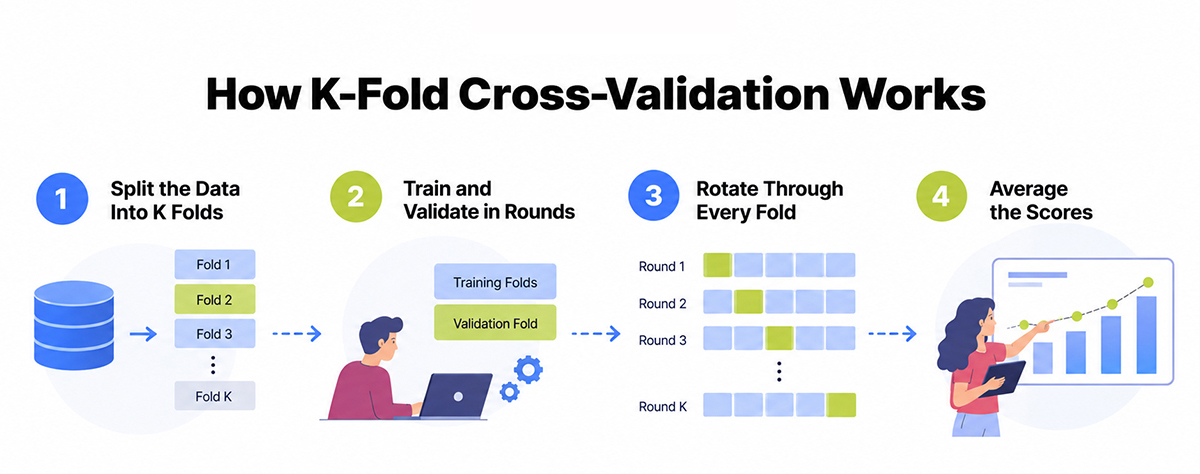
- Step 1: Split the data into k folds. Divide your dataset into k equal parts, or folds. A common choice is k equals five, which produces five folds of roughly equal size.
- Step 2: Train and validate in rounds. In each round, hold one fold back for validation and train the model on the remaining k minus one folds. With five folds, you train on four and validate on the fifth.
- Step 3: Rotate through every fold. Repeat the process so that each fold serves as the validation set exactly once. Five folds means five rounds, and every data point is validated exactly one time.
- Step 4: Average the scores. Collect the validation score from each round and average them into a single performance estimate. That average is your cross-validated result, and its spread across the folds tells you how stable the model is.
Here is how a five-fold cross-validation looks in Python using scikit-learn:
from sklearn.model_selection import cross_val_score
from sklearn.ensemble import RandomForestClassifier
model = RandomForestClassifier(random_state=42)
# Run 5-fold cross-validation and collect the score from each fold
scores = cross_val_score(model, X, y, cv=5, scoring="accuracy")
print(f"Fold scores: {scores}")
print(f"Mean accuracy: {scores.mean():.3f}")
print(f"Standard deviation: {scores.std():.3f}")
The mean indicates expected performance, while the standard deviation shows variability across folds. A low standard deviation signals a stable model, while a high one warns that performance depends heavily on which data the model trains on.
Common Cross-Validation Techniques
K-fold is the default, but several variations handle situations where plain k-fold falls short. Choosing the right one depends on the shape and structure of your data:
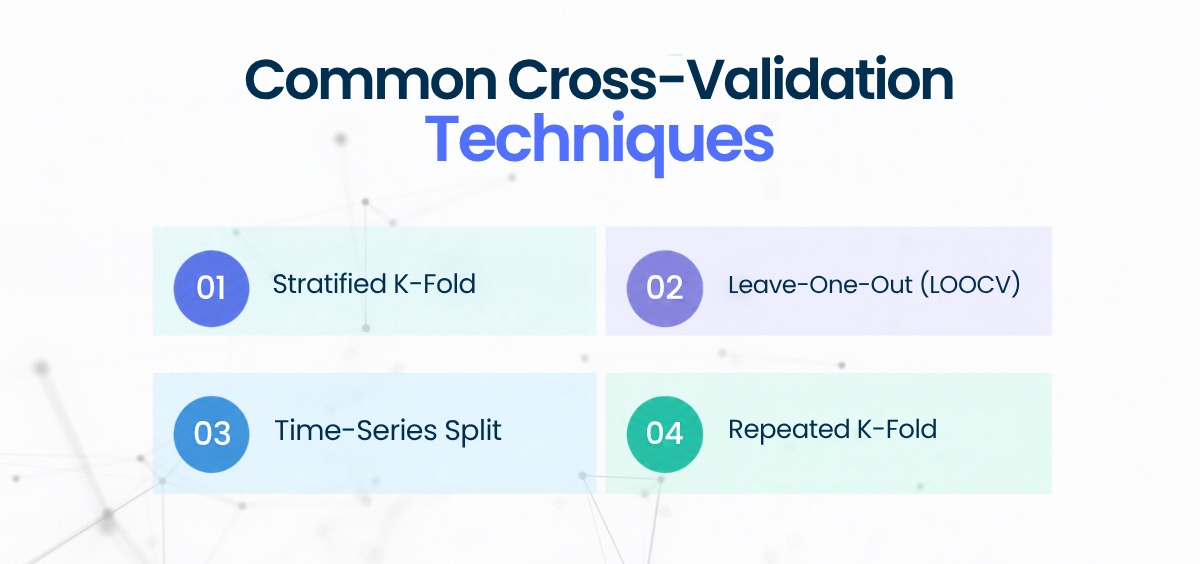
- Stratified k-fold. This version preserves the proportion of each class in every fold, which matters when your classes are imbalanced. If only 5 percent of your data belongs to the positive class, stratification keeps that 5 percent balance in each fold so no fold ends up with too few positive examples to validate against.
- Leave-one-out (LOOCV). Leave-one-out cross-validation takes k to its extreme by holding out a single data point for validation and training on everything else, repeated for every point. It extracts the maximum information from a tiny dataset, though the computational cost grows steeply as the data grows.
- Time-series split. When your data has a time order, ordinary shuffling would let the model train on future data to predict the past. A time-series split respects chronology by always training on earlier data and validating on later data, which mirrors how the model will actually be used.
- Repeated k-fold. This runs the whole k-fold process several times with different random splits and averages across all of them, which further reduces the influence of any single partitioning when you need an especially stable estimate.
Every variation here targets a specific weakness in plain k-fold, so the right choice follows directly from what your data looks like and how it will be used.
How to Choose the Right Method
The right cross-validation method follows from a few properties of your data and your problem. Working through them in order points you to the appropriate technique without guesswork:
- Data structure. If your observations have a time order, such as daily sales or sensor readings, a time-series split is the only correct choice because any method that shuffles the data would leak future information into the past.
- Class balance. For a classification problem with uneven classes, stratified k-fold protects you from folds that accidentally exclude a rare class and skew the estimate.
- Size against compute cost. Leave-one-out extracts the most from a small dataset but becomes impractically slow on a large one, where standard five-fold or ten-fold cross-validation gives you a reliable estimate at a reasonable cost.
Work through them in order, since data structure settles the choice for ordered data before class balance and dataset size come into play.
Common Mistakes to Avoid
A few recurring errors undermine cross-validation even when the mechanics look correct:
- Data leakage. Information from the validation set slips into training and inflates the score. This happens most often when you scale features or fill in missing values across the entire dataset before splitting. The fix is to fit every preprocessing step inside the cross-validation loop, on the training folds alone.
- The wrong method for the data. Ordinary k-fold on time-series data lets the model train on future observations to predict the past, and plain k-fold on heavily imbalanced classes can produce folds with too few examples of the rare class to mean anything.
- Tuning against the test set. Adjusting a model to improve its test-set score quietly turns your final held-out data into part of the training process and destroys its value as an unbiased check.
Avoiding these mistakes matters as much as running cross-validation at all, since a leaky or mismatched validation produces a confident number that fails in production.
Where Cross-Validation Fits in Model Evaluation
Cross-validation is a tool for two specific jobs, comparing candidate models and tuning their settings. When you are choosing between a random forest and a gradient boosting model, or searching for the best hyperparameters, cross-validation supplies the trustworthy performance estimate that makes the comparison fair. It answers the question of which model and which configuration generalize best.
It works alongside a final test set and does not replace it. You use cross-validation on your training data to select and tune the model, then evaluate the chosen model once on a held-out test set it has never touched, which confirms the performance estimate on genuinely fresh data. Keeping that final test set untouched until the very end is what preserves it as an honest measure.
This disciplined approach to validation is a defining skill of a capable data scientist. The Senior Data Scientist (SDS™) certification addresses the model evaluation and machine learning methods that mark a reliable practitioner. That discipline is what carries a model from strong results in a notebook to dependable performance in production.
Conclusion
Cross-validation is how you find out whether a model has learned a real pattern or merely memorized its training data, before that answer costs you in production. By testing across multiple splits and averaging the results, it turns a noisy single measurement into a dependable estimate of real-world performance on data the model has never seen.
The method you choose should match your data, with stratification for imbalanced classes and a chronological split for time-ordered data. Your preprocessing belongs inside the validation loop, which keeps the estimate honest. Correct application of these choices ensures that cross-validation provides a reliable measure for models that generalize beyond their training data.