


















Your organization has probably invested heavily in AI by now.
But if your AI projects keep stalling at the pilot stage, the issue likely has nothing to do with your models or your team.
It almost always comes back to the data infrastructure. The systems storing and moving your data were built for traditional reporting and batch analytics.
They were not designed to handle the speed and complexity that AI workloads demand. And if that foundation is weak, the AI initiatives built on top of it inherit those same limitations. Such as poor outputs, slow pipelines, models that work in testing but fall apart during production.
This is why a sound artificial intelligence strategy begins with the data layer, not the algorithms or platforms on top of it.
This article walks you through what AI-ready data infrastructure actually involves, why it matters, and how to build one from the ground up.
What Is AI-Ready Data Infrastructure?
AI-ready data infrastructure is the technology and governance foundation that makes your data usable for AI at scale. It ensures your data is clean and connected, flowing in real time so AI models can train and perform reliably in production environments.
This is important because AI workloads are fundamentally different from traditional reporting and batch analytics. They depend on continuous data feeds and automated quality controls running on systems built for speed and volume.
Without such a foundation, AI models can either underperform or fail to reach production entirely. Getting your data infrastructure right is what determines whether AI becomes a competitive advantage or an expensive experiment.
Why Modern Enterprises Need a Scalable AI Data Platform
There is a significant gap between AI ambition and actual data readiness. Research shows that nearly 90% of AI projects (CIO.com) fail to move beyond experimentation. The root cause is often that the underlying data infrastructure was not built to support AI.
A scalable AI data platform closes that gap. It gives your organization the foundation to move AI from pilot to production and deliver outcomes that go far beyond basic analytics.
- Faster and smarter decision-making: Real-time data pipelines feed insights directly to decision-makers. This reduces the lag between data collection and action.
- Personalized experiences at scale: Predictive intelligence enables you to tailor customer and user experiences based on live behavioral data rather than static segments.
- Operational efficiency through automation: Autonomous workflows replace manual processes, freeing your teams to focus on higher-value work.
- Scalable performance across industries: A cloud-native AI platform scales compute and storage on demand, ensuring infrastructure in industries like manufacturing or healthcare keeps pace with data growth.
Core Components of an AI-Ready Enterprise Data Architecture
Once you are clear on why AI-ready infrastructure matters, the focus shifts to what goes into building one. It is not a single platform or tool. It is a holistic enterprise data architecture where every layer works together to support AI at scale.
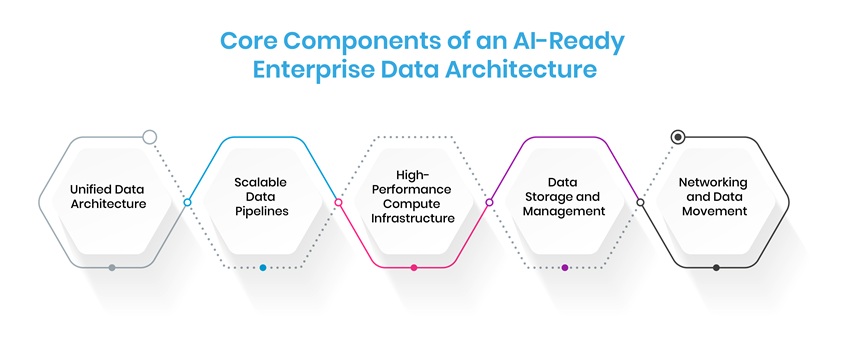
Here are the essential building blocks you need to get right.
- Unified Data Architecture: AI models need complete and consistent data to perform well. A unified architecture built on frameworks like data lakehouse or data mesh brings structured and unstructured data together into a single accessible layer. Without this, your data stays locked in departmental silos and your models only ever see part of the picture.
- Scalable Data Pipelines: Pipelines handle the ingestion, transformation, and delivery of data from source systems to AI models. For AI to work reliably, these pipelines need to operate in real time, cleaning and enriching data as it flows. Slow or fragile pipelines mean your models train on stale data, and the outputs reflect that.
- High-Performance Compute Infrastructure: Training AI models requires dedicated processing power that traditional servers cannot provide. GPU (Graphics Processing Unit) and TPU (Tensor Processing Unit) clusters handle the parallel processing needed for large-scale training, while cloud-native environments let you scale resources based on demand.
- Data Storage and Management: Your storage layer determines how effectively AI systems can access and use your data. Object storage handles raw datasets and model artifacts. Vector databases power semantic search and recommendation systems. Feature stores serve pre-processed, ML-ready data directly to models. The same principles of structured data management transforming data science in education apply directly to enterprise AI.
- Networking and Data Movement: AI systems rarely run in a single location. Data needs to move between edge devices, cloud platforms, and on-premises systems without creating bottlenecks. High-bandwidth interconnects and edge-to-cloud connectivity ensure data reaches the right place at the right time.
Key Steps to Build AI-Ready Data Infrastructure
Now that you understand the core components, here is how to put them into action. These seven steps will help you build AI-ready data infrastructure in a structured and scalable way.
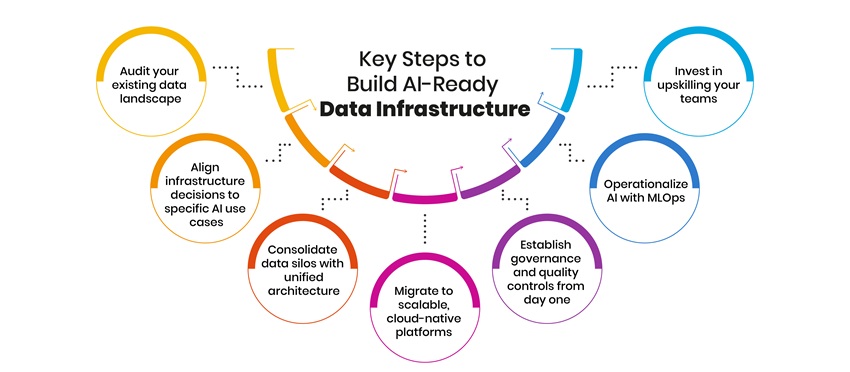
Step 1: Audit your existing data landscape. Map every data source across your organization, assess quality levels, and document how data flows between systems. This is where hidden problems like duplication, inconsistency, and gaps surface. You cannot build a reliable AI foundation on data you have not measured.
Step 2: Align infrastructure decisions to specific AI use cases. Anchor every investment to a defined business outcome. A logistics company building demand forecasting models needs real-time supply chain pipelines. An institution building adaptive learning platforms needs clean learner data and flexible content delivery. The use case dictates the architecture, not the other way around.
Step 3: Consolidate data silos with unified architecture. Break down departmental barriers by bringing data into a single accessible layer. JPMorgan Chase adopted a data mesh architecture that decentralized data ownership while enabling enterprise-wide sharing and visibility. The result was a stronger foundation for AI-driven fraud detection and risk analysis across business lines.
Step 4: Migrate to scalable, cloud-native platforms. Move away from fixed-capacity infrastructure that limits your ability to scale. Capital One exited all of its data centers and migrated entirely to AWS over an eight-year journey. The move cut environment provisioning from months to minutes and enabled its data science teams to scale compute on demand.
Step 5: Establish governance and quality controls from day one. Implement lineage tracking, metadata management, and compliance frameworks before scaling any AI initiative. Just as a certification establishes a professional’s competency, a governance framework validates the integrity of your data. Without them, even clean data becomes a liability when regulators come asking.
Step 6: Operationalize AI with MLOps. Automate how your models move from training to production and stay healthy over time. A strong MLOps framework standardizes deployment, monitors model performance, and triggers retraining when outputs start to drift. Without this layer, models degrade silently in production.
Step 7: Invest in upskilling your teams. Build internal data literacy so your people can work with modern tools and interpret AI outputs confidently. Pairing hands-on training programs with broader workforce development initiatives is how you build a culture that sustains long-term AI success.
Common Challenges in Building Enterprise AI Data Infrastructure
Even with a clear roadmap, building AI-ready data infrastructure comes with real obstacles. Most of these challenges are not purely technical. They span people, processes, and legacy decisions that compound over time. Here are the most common barriers enterprises face on this journey.
- Data Silos and Fragmentation: Many enterprises still operate with isolated data systems across departments. This prevents unified access and makes it difficult to build the connected datasets that AI models need to perform effectively.
- Legacy System Constraints: Architectures built for batch analytics and periodic reporting cannot handle real-time AI workloads or the data volumes modern models require. Migrating away from these systems takes time, budget, and careful planning.
- Talent and Skills Gaps: Skilled data engineers, ML engineers, and AI specialists remain in high demand. Without the right expertise in-house, even well-funded initiatives can stall.
- Budget and Organizational Resistance: Leadership teams that have yet to see measurable returns from AI are often hesitant to commit further investment. This resistance slows modernization efforts across the board.
- Pace of Technological Change: The rapid evolution of AI tools and platforms means that today’s cutting-edge solution can quickly become outdated if your architecture is not designed for adaptability.
How To Future-Proof Your AI Data Infrastructure
AI-ready data infrastructure is an evolving strategy that must keep pace with rapidly advancing technology and shifting business demands.
Emerging trends like edge AI, federated learning, and AI-native databases are already reshaping how enterprises handle data at scale. Technologies like generative AI are pushing the boundaries of what intelligent systems can achieve, demanding even more flexible data foundations.
The need for continuous learning and workforce upskilling will only intensify. AI infrastructure is a living system that requires ongoing investment in both technology and people.
Professionals looking to stay ahead can explore structured learning paths through programs like DASCA’s data science certifications to build the skills this evolving landscape demands.
Organizations prioritizing forward-looking data strategies today will be better positioned to lead across industries. The enterprises that master their data foundations now will define the intelligent economy of tomorrow.
Conclusion
AI-ready data infrastructure is the backbone behind any successful AI initiative. Focusing on unified architecture, scalable platforms, strong governance, and continuous workforce development, it lets you build a data foundation that supports your current AI goals and adapts to whatever comes next. The time to start is now. In the race toward intelligent enterprise, your data infrastructure is the starting line.
FAQs
What does AI-ready data infrastructure mean?
It refers to the systems, platforms, and governance frameworks that enable organizations to collect, process, and scale data specifically for AI and machine learning workloads.
Why do most enterprise AI projects fail?
Most AI projects stall because the underlying data infrastructure lacks the quality, integration, and scalability needed to move beyond the pilot stage.
What are the core components of an AI-ready enterprise data architecture?
The key components include unified data architecture, scalable data pipelines, high-performance compute (GPUs, TPUs), adaptable storage systems, and robust networking for data movement.
How is AI-ready infrastructure different from traditional data infrastructure?
Traditional infrastructure handles batch processing and periodic reporting. AI-ready infrastructure supports real-time ingestion, continuous model training, and automated governance at scale.
What role does data governance play in AI infrastructure?
Governance ensures the data feeding your AI models is accurate, secure, and compliant through quality monitoring, metadata management, lineage tracking, and ethical safeguards.