













In the modern digital economy, each click, transaction, and conversation generates data, and knowing where that data resides has become essential for long-term success. Managing its location, accessibility, and security is no longer just a technical task but a core business priority that drives efficiency, compliance, and innovation. Data storage management is not just about keeping the files secure, but it also ensures that the data is arranged, made available, and dependable even in a complex environment. Starting with cloud platforms and moving up to on-premise systems, effective storage planning can drive business agility, security, and innovation, which has become a key cornerstone of contemporary data management.
What Data Storage Management Really Means
In the contemporary digital environment, data management storage is beyond locating space in a server. It includes the entire data lifecycle, including creation and indexing through access, archiving, and governance. It is also compatible with broader data-management systems that centralize different formats and locations.
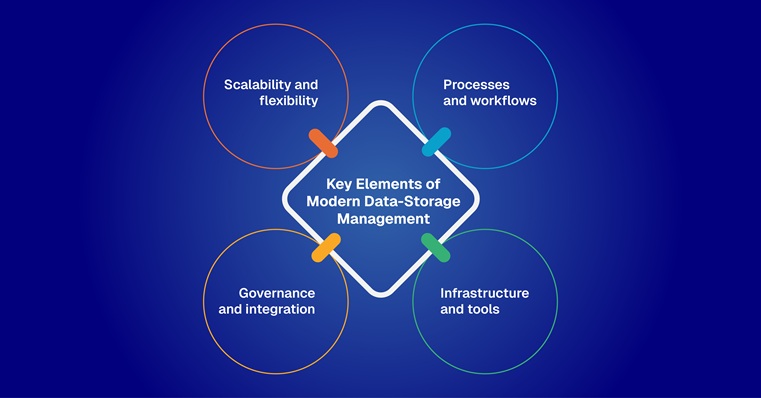
The main elements of contemporary data-storage management are:
- Processes and workflows: Determine the data ingestion and cataloguing processes, data flow between levels, backup, and update, as well as the ultimate retiring process.
- Infrastructure and tools: Enable the coexistence of structured records, unstructured logs, and multimedia files by supporting hybrid environments on-premises, in the cloud, and at the edge, and provide a common policy framework.
- Governance and integration: Coordinate storage practices, access controls, audit trails, metadata standards, and compliance requirements so that the efficient operation of business units can be effected.
- Scalability and flexibility: Respond to increasing data volumes. Recent data storage outlooks estimate global data volumes will surpass the 175 zettabyte benchmark projected for 2025, continuing to grow at an annual rate of about 30–40 percent through 2026.
Overall, data-storage management is not a standalone IT operation today but a business layer in the enterprise architecture. It has guaranteed stable, economical access and alignment to governance, as well as the business needs and new sources of data.
The Hidden Complexity Behind Every File Saved
All digital files might appear insignificant, yet each of them is supported by the stratified system of storage systems, data formats, and compliance regulations. This complexity is increased when organizations handle structured, semi-structured, and unstructured data. According to the study by IDC “Data Age 2025,” the amount of data generated all over the world is estimated at 163 zettabytes in 2025, which illustrates the magnitude of the challenge.
- Diverse Data Types Require Dynamic Storage
Video archives, sensor logs, text documents, etc., require particular methods of storage. Companies need to trade off between speed, cost, and accessibility of every type of data. The one-size-fits-all models cause inefficiencies, particularly in hybrid environments that cut across on-premises and cloud storage.
- Scalability Challenges in Growing Enterprises
The traditional storage models are behind when data volume increases. Scalability must be dynamic so that the resources can be maintained without excessive use of resources on idle capacity. Striking this balance is supported by automated tiering, compression, and smart allocation tools.
- Compliance and Data Sovereignty Concerns
Storing data across borders involves legal and regulatory risks. Companies are required to adhere to privacy, retention, and audit regulations that are region-specific. Failure to comply with may result in stiff fines and loss of trust and reputation.
- Evolving Security and Accessibility Demands
Securing information and providing instant access is always a trade-off. It is now obligatory to encrypt, use multi-factor access controls, and monitor in real time. The non-adaptation of companies can lead to the risk of data breaches and decreased operations.
The Importance of Data Storage in Business Resilience
Resilience in business is based on strong data storage. It allows organizations to come back, change, and continue operating in the event of disruption. In a data-driven economy, data loss can stop business, destroy trust, and otherwise harm the reputation of a company. According to the IDC 2025 DataSphere Report, 70 percent of businesses have improved the availability of data as the primary source of operational resilience.
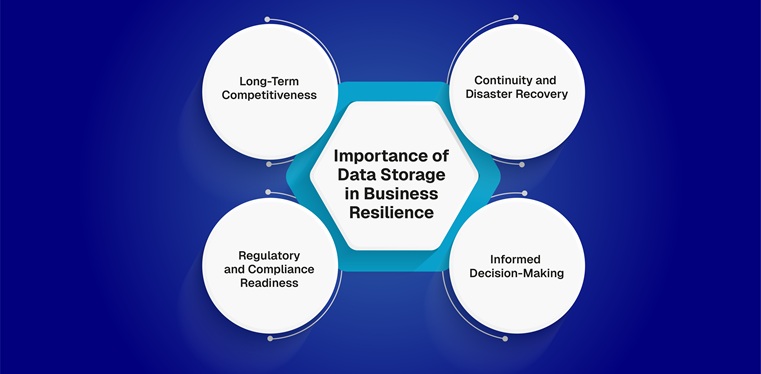
- Continuity and Disaster Recovery:
Good data systems safeguard operations in unanticipated occurrences. The backup systems, data replication, and off-site recovery reduce the wasted time to a minimum, and restore services are fast. An organized strategy reduces the risk of data loss and facilitates smooth continuity in case of system failures and computer attacks.
- Informed Decision‑Making:
Accurate, timely, and comprehensive data on reliable storage provides decision-makers with the right information. A properly structured repository helps in making quick strategic decisions, particularly in a market that is volatile. A clean data space also aids in forecasting and risk evaluation.
- Regulatory and Compliance Readiness:
Secure storage includes compliance with industry regulations and data privacy regulations. Companies demonstrate compliance in case of an audit and evade punishment by having traceable, well-archived records. Good governance generates trust among stakeholders and enhances corporate accountability.
- Long‑Term Competitiveness:
The cost of operation is reduced through efficient storage, and scalable innovation is fueled. Through effective management of information assets, organizations shift gears quickly, introduce innovative solutions, and react to the changes in the market with assurance. Information is a strategic asset that is here to stay.
Modern Data Management Systems: From Legacy to Intelligent
Data management systems over the last ten years have transformed into dynamic, intelligent ecosystems, as opposed to manual and server-based systems. This change is motivated by the increase in the amount of data, remote workplaces, and the necessity to access real-time information. Modern organizations require flexible architectures that will be able to store, process, and protect information both on-premises and in the cloud without the formation of silos.
The major developments that have influenced the contemporary systems are:
- A streamlined backup, recovery, and optimization that is automated and uses artificial intelligence.
- Tiered storage is defined by assigning data to what is used and its importance to reduce costs.
- A trust framework that enforces encryption, identity, and end-to-end monitoring.
- Scalability is hybrid and can transfer data across and between private and public storage layers.
Such changes transform how firms handle digital assets and the quality of managing information lifecycles. The data systems of the new generation are concerned with scalability, affordability, and stability in the face of exponentially growing data. The 2025 Gartner Data Infrastructure study revealed that more than 78 percent of all world businesses have adopted or are moving to intelligent storage systems that are geared towards predictive management and compliance.
Governance, Security, and Compliance: The New Mandates
The management of data storage in an organization should be governed and subject to stringent governance and compliance requirements as organizations deal with bigger and more sensitive datasets. Governance is used to make sure that all data is classified, traceable, and utilized ethically. Security is based on this, as it will protect the data against internal and external threats by encryption, access control, and continuous monitoring.
Key practices include:
- Development of retention and deletion policies to control the data lifecycle.
- Ensuring accountability and transparency through the maintenance of audit trails.
- Using encryption and role access to avoid unauthorized exposure.
- Frequently revising the compliance frameworks to match international data privacy regulations.
The combination of these practices makes the data management systems reliable and secures the integrity of the business. Governance and compliance are no longer a choice; they dictate trust in a data-driven world where all files are of regulatory and reputational value.
Conclusion
The management of data storage has become the key to the functioning of organizations, the protection of assets, and readiness for the future. Using secure frameworks, adaptable automation, and long-lasting infrastructure, companies can transform storage into a strategic asset. The actual potential is to develop storage ecosystems that are less brash and more compliant and reliable in the long term as data management systems become smarter and more efficient.