








A credit algorithm denies a loan to a qualified applicant. A hiring system filters out a capable candidate before human eyes ever see the resume. These aren't random failures.
The pipeline problem started decades ago. Women earned around 37% of computer science degrees in the mid-1980s, a number that seemed to promise growing gender balance in tech careers. Instead, that share collapsed to roughly 18-20% by the mid-2010s. The damage from that decades-long decline still echoes through data science today.
Why Representation Creates Better Data Science
When one demographic group dominates data teams, blind spots appear in products, research, and policies. The people deciding which questions to ask often have vastly different lived experiences from those most affected by the outcomes.
Studies on AI systems reveal that biased training data, combined with homogeneous teams can produce models that underserve or actively harm underrepresented groups. Research shows prediction errors correlate within demographic groups, but combining predictions across multiple demographic groups, including gender, tends to improve overall algorithmic performance.
Consider healthcare algorithms that predict which patients need extra care. If the team building these models consists primarily of one demographic, they might miss patterns affecting women's health outcomes differently than men's. The same principle applies to financial models, hiring algorithms, and cybersecurity protocols.
Improving gender balance is a practical step toward more robust, trustworthy data science that serves everyone better.
The Numbers Tell a Stark Story
There's no single global statistic, but different studies paint a consistent picture. According to a 2024 report by Anaconda published in scientific research, women represent roughly 23% of data science professionals globally, even though they represent about half the population.
The broader tech landscape shows similar patterns:
- Women hold approximately 27% of global technology positions
- Around 20% of software developers are women
- Women occupy fewer than 20% of executive and board-level positions in technology firms
- Female representation in cybersecurity remains around 20%, despite critical workforce shortages
Pay gaps persist alongside representation gaps. Industry salary surveys track noticeable differences in earnings between men and women in similar roles, with larger disparities in specialized analytics fields. Even when more women enter the field, they're often concentrated in junior or lower-paid positions.
Where the Pipeline Breaks Down
The gender gap in data science doesn't start at the hiring stage. It emerges step by step, from early education through first job offers and beyond.
Early Education and Stubborn Stereotypes
Girls and boys show similar interest in science and technology in primary school. Differences appear as social expectations harden during the early teen years. By secondary school, girls are less likely than boys to choose computing or advanced math courses, even when their grades match or exceed their male peers.
Research consistently highlights the impact of stereotypes about who is "naturally good at" coding or math. Subtle comments from teachers, parents, and peers add up to a strong signal that STEM isn't for them. These messages compound over time.
The Role Model Problem
If you rarely meet women who work as data scientists, machine learning engineers, or analytics leaders, picturing yourself in those roles becomes difficult. Many students can name doctors or lawyers they know but cannot describe what a data scientist actually does day to day.
That lack of concrete examples hits students without tech industry contacts hardest. When you don't see anyone like you in a field, opting out early becomes the path of least resistance.
Perceptions of Tech Culture
Popular images of tech often emphasize long hours, aggressive competition, and lone genius programmers. For students who expect to take on caring responsibilities or who value collaborative work, those images can be off-putting.
Stories of discrimination or harassment in tech, widely covered over the last decade, send a powerful message about who will feel safe and respected. These perceptions reflect real experiences reported by women already in the field.
The Retention Challenge Nobody Talks About Enough
Getting into data science represents only part of the challenge. Retention is where many organizations lose talented women, and the reasons deserve close examination.
Unequal Experiences at Work
Surveys of women in tech repeatedly report higher rates of bias, microaggressions, and doubts cast on technical ability compared with male colleagues. Leaders such as Jana Eggers and Lillian Pierson have described persistent scrutiny of women's appearance and behavior in ways men don't face. These experiences erode confidence and job satisfaction over time. They make it harder for women to be seen as leaders or senior technical experts, regardless of their actual capabilities.
Career Progression Roadblocks
Several large studies reveal that women in technical roles are significantly more likely than men to leave their jobs. Common reasons include lack of promotion opportunities, slow pay progression, and cultures where informal networks and insider status matter more than clear performance criteria.
The Flexibility Trap
Women remain more likely than men to take time away from paid work to care for children and other family members. If organizations treat any break as a lack of commitment, or if flexibility exists only on paper, caregivers of all genders will struggle.
For women, this often translates into stalled progression, sidelined projects, or complete exits from technical tracks after returning from leave.
The Technical Skills Barrier for Beginners
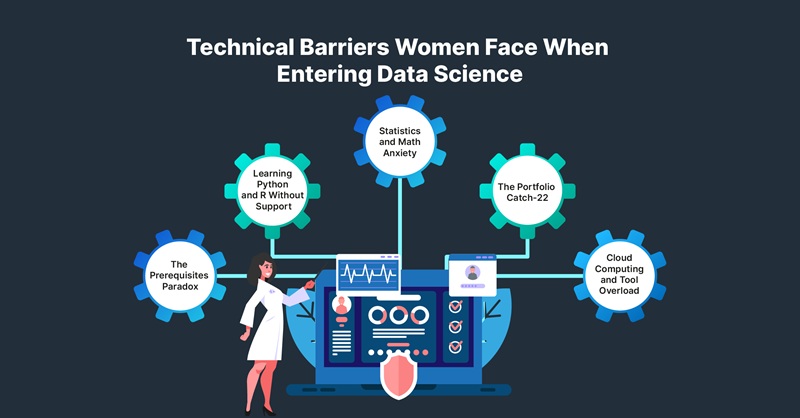
Women trying to enter data science face specific technical hurdles beyond general workplace culture issues. Understanding these barriers helps identify where interventions can make the most difference.
The Prerequisites Paradox
Men, research shows, apply to jobs when they meet about 60% of qualifications. Women tend to apply only when they meet nearly 100%. This confidence gap hits particularly hard in data science, where rapidly evolving tools make it impossible to master everything before starting.
The paradox deepens because many listed "requirements" aren't actually required. Employers often use inflated job descriptions, then hire candidates who show potential to learn. Women who take these postings at face value miss opportunities they're qualified for.
Learning Python and R Without Support
Free learning resources exist everywhere, but determining which ones to trust takes expertise beginners don't have. Should you start with Python or R? Which courses actually teach practical skills versus academic theory? How do you know if you're learning the right libraries?
Women who lack existing networks in tech struggle to get these questions answered. The path from "I want to learn data science" to "I can apply for jobs" remains unclear, with countless decision points where women might choose wrong and waste months on less relevant skills.
Statistics and Math Anxiety
Data science requires statistical thinking, which many people find intimidating. Women, who've often received subtle messages that they're "not math people," may doubt their ability to learn probability, hypothesis testing, or linear algebra.
This anxiety can be paralyzing. Looking at data science curricula heavy with mathematical notation, some women conclude they don't have the right background. They might have taken statistics in college but forgotten the details. The gap between "I learned this once" and "I can apply it confidently" feels insurmountable.
The Portfolio Catch-22
Women starting from scratch face a catch-22. They need projects to get interviews, but don't know what projects will impress employers. Should they focus on Kaggle competitions? Build a personal project? Contribute to open source? Each path requires different skills and time investments.
Finding good datasets for practice projects isn't straightforward. Cleaned, well-documented datasets aren't representative of real work, but messy real-world data overwhelms beginners. Women trying to build portfolios often spend excessive time on data cleaning, not realizing employers care more about analytical thinking than perfect datasets.
Cloud Computing and Tool Overload
Women trying to learn data science must navigate decisions about which tools matter. Should you learn Jupyter notebooks or work in VS Code? Is Docker important for beginners? What about version control with Git? The tool ecosystem expands constantly, and every tutorial assumes familiarity with different stacks.
This tool overload creates analysis paralysis. Time spent researching which tools to learn is time not spent actually learning. Women without mentors to say "just start with these three things" waste effort optimizing their learning path instead of walking it.
Practical Steps Organizations Can Take Now
The gender gap in data science results from many small decisions. Different choices can move teams in a better direction.
Make Hiring and Promotion Processes Fair
Use structured interviews with the same questions and scoring criteria for every candidate. Focus on skills and problem-solving tasks directly tied to the work, not on obscure brain-teasers that favor certain backgrounds.
Review job descriptions for unnecessary requirements and language that might discourage qualified candidates. Track who gets promoted, how quickly, and with what pay changes so you can spot inequities early and address them.
Build Inclusive Team Culture
Set clear expectations that everyone is responsible for respectful behavior. Establish meeting norms that make space for all voices and discourage interruptions. Diverse teams produce more creative and effective solutions, in data science, where innovation drives progress, diversity becomes a significant advantage.
Take reports of bias or harassment seriously and respond transparently. Support employee-led groups for women and other underrepresented communities, giving them real input into policies rather than token acknowledgment.
Support Flexible, Sustainable Careers
Offer flexible hours and remote-friendly practices wherever the work allows. Design parental leave for all genders and encourage everyone to use it fully. Create re-entry or upskilling programs for people returning from career breaks so they can come back at an appropriate level.
Invest in Learning, Mentoring, and Sponsorship
Provide clear growth paths from junior analyst to senior data scientist or manager. Pair early-career staff with mentors who can offer both technical guidance and career advice. Encourage senior leaders to actively sponsor promising staff by recommending them for stretch projects and promotions.
Structured learning programs can build skills and confidence. Intensive bootcamps give learners hands-on experience with real projects, peer support, and guidance from instructors who work in the field.
Resources and Communities Making a Difference
Women now represent 35-40% of participants in tech bootcamps worldwide, reflecting growing access to alternative education pathways. Global initiatives such as Women in Tech, Girls Who Code, and AnitaB.org provide mentorship, networking, and career development opportunities that help retain women in technology.
YouTube has become an unexpected resource for aspiring data scientists. Channels led by women offer accessible tutorials and career guidance:
- Data Interview Pro by Emma Ding, an ex-Airbnb data scientist, prepares viewers for data science interviews
- Jordan Harrod covers AI, machine learning algorithms, and new technologies
- Tina Huang, a data scientist at a FAANG company, helps with transitions into data science and productivity
- Cassie Kozyrkov, head of decision intelligence at Google, offers approachable explanations of statistics and AI
- Anastasia K, a data scientist at a Stockholm-based music startup, helps kick-start careers in data science and analytics
These resources democratize access to knowledge, providing role models and practical guidance that traditional education sometimes misses.
Getting Started in Data Science in 2026
If you're curious about data science, you don't need a perfect background to start. Many successful data professionals began in fields like economics, biology, social sciences, or design. What matters is building core skills in programming, statistics, and communication, then applying them to real problems.
Some practical steps you can take this year:
- Learn or strengthen a programming language such as Python
- Build foundations in statistics and probability
- Practice using tools like pandas, NumPy, and scikit-learn on real datasets
- Join online or local data communities to meet peers and potential mentors
- Create a small portfolio of projects you can show to employers
Female enrollment in AI-related programs is growing, reaching close to 35% in some regions, according to the Scholars International Institute of Technology. Educational participation is increasing thanks to scholarships, mentorship programs, and awareness campaigns.
Why Does This Matter for Everyone?
Data science shapes public policy, healthcare, and societal norms. Women have historically been excluded from important discussions, research, and policy decisions that directly affect their lives. Without their voices, data-driven solutions risk overlooking the needs of half the population.
The inclusion of women in data science leads to more accurate, innovative, and impactful outcomes better suited to tackle complex challenges. When teams lack diverse experiences and perspectives, the resulting insights are inevitably limited.
Increasing representation of women in data science requires sustained action and systemic change. Institutions and organizations must provide tangible support through targeted mentorship programs, dedicated funding, and training to address unconscious biases.
Institutions should actively promote the visibility and recognition of women's contributions by ensuring fair authorship opportunities, competitive salaries, transparent promotion pathways, and unbiased consideration for awards. These concrete measures are essential for fostering an environment where women can fully contribute while dismantling systemic barriers that have historically disadvantaged them.
Looking Ahead
Remote work and digital collaboration platforms are expanding opportunities for women in regions with traditional barriers. Corporate diversity programs are becoming more sophisticated, moving beyond checkbox exercises to genuine cultural change. Governments worldwide are implementing initiatives to encourage women in STEM, ranging from educational subsidies to leadership development programs.
The path forward requires sustained effort from multiple directions. Educational institutions need to address stereotypes early and provide visible role models. Companies must examine their hiring, promotion, and retention practices with honest scrutiny. Policymakers can incentivize meaningful change through targeted programs and accountability measures.
Women data scientists are already redefining what's possible in healthcare predictive modeling, cybersecurity threat detection, and countless other applications. Their visions are becoming impact, one dataset and one algorithm at a time.
Closing the gender gap in data science strengthens innovation, improves decision-making, and ensures that technology serves everyone equitably. The women entering the field today are building on the foundations laid by Lovelace, Nightingale, Johnson, Hopper, and Li. Their work will shape the future of AI, cybersecurity, healthcare analytics, and emerging sectors. Making sure they have the support, recognition, and opportunities they deserve is essential for building technology that works for everyone.
Frequently Asked Questions (FAQs)
Q. How do visible role models and mentorship influence women’s participation in data science and AI?
A. Visible role models and strong mentorship play a critical role in encouraging women to enter and remain in data science and AI. When women see other women successfully leading in these fields, it challenges early stereotypes and shows that these careers are achievable.
Q. Why are fewer women pursuing data science careers?
A. The gap emerges through multiple stages. Girls receive subtle messages from an early age that STEM "isn't for them." By secondary school, they're less likely to choose computing or advanced math courses even with similar grades. The lack of visible role models, perceptions of hostile tech culture, and intimidating job requirements that list exhaustive technical prerequisites all discourage women from entering the field.
Q. What technical skills do I need to start in data science?
A. Begin with Python programming, foundational statistics and probability, and common data science libraries like pandas, NumPy, and scikit-learn. Practice on real datasets to build a portfolio. You don't need to master everything before starting. Many successful data scientists came from non-technical backgrounds like economics, biology, or social sciences and learned programming skills along the way.
Q. How do women-led data teams improve outcomes?
A. Prediction errors correlate within demographic groups, but combining predictions across diverse groups improves algorithmic performance. Women bring different perspectives that help identify blind spots in models, ask different questions during development, and ensure data-driven solutions consider a wider range of community needs. This leads to more robust, trustworthy data science.
Q. What can organizations do to retain women in data science?
A. Implement structured interviews with consistent evaluation criteria, review job descriptions for unnecessary requirements, offer genuinely flexible work arrangements with equal parental leave for all genders, create clear promotion pathways with transparent performance criteria, establish re-entry programs for career breaks, and take reports of bias or harassment seriously with transparent responses. Companies that design truly flexible roles see better retention across the board.