











A data engineer’s week disappears into maintenance long before it reaches the work that matters. Pipelines that ran cleanly last month break when an upstream schema changes, a job fails at two in the morning, and the fix consumes hours that were meant for building new capabilities. As pipeline counts climb into the hundreds and thousands, that maintenance load grows faster than any team can staff against it.
Agentic data engineering is the response taking shape across the industry. It moves the construction and repair of pipelines to AI systems that reason about a goal and act on it, correcting themselves when conditions change, with the engineer directing the work at a higher level. The technology is no longer a laboratory demonstration. Platform vendors shipped production agents in 2026, and data teams are already assigning them real production tasks.
This article explains what agentic data engineering is and how the systems work, then covers what they actually do, why the shift is happening now, and the parts of the job that remain firmly human. It closes with how the data engineer’s role is changing and how you can prepare for it.
What Is Agentic Data Engineering?
Agentic data engineering is an approach in which AI agents build and maintain data pipelines with limited human direction, adapting to change as it happens. An agent receives a goal, plans a path toward it, and executes that plan, adjusting whenever the environment shifts.
This differs from the traditional model in a specific way. A conventional Extract, Transform, Load (ETL) pipeline follows rules an engineer wrote in advance, running on a schedule and failing when reality departs from those rules. Ordinary automation repeats a fixed task without deciding anything. An agentic system, by contrast, makes decisions. It chooses how to reach the goal it was given and revises that choice as data and conditions move, which is what separates it from a scheduled job that can only do exactly what it was told.
The practical result is a pipeline that continuously adapts to achieve the targeted outcome it was asked for as the data around it moves.
How Agentic Pipelines Work
The engine of an agentic pipeline is a loop of four stages that repeat continuously. In this perceive-reason-act-learn cycle, the agent perceives the state of its data and pipelines, reasons about what the situation requires, acts by running or modifying a workflow, and learns from the outcome to improve its next decision.
Sitting above that loop is an intent layer, and it changes the engineer’s job most. You specify the outcome you want, and the system determines the steps to reach it. That outcome covers what the data should look like and how fresh it needs to be, together with the quality it must meet.
The system then works out the individual steps, and keeps adjusting them as sources change. A traditional pipeline executes the instructions it was given. An agentic pipeline pursues the result it was asked for, which becomes a meaningful difference when an upstream source changes without warning.
The Work Agents Take On
The capabilities have moved well past generating a snippet of code. Where earlier tools could suggest a transformation for an engineer to review, a current agent carries a task from specification to working pipeline and then keeps it running. A production agent now handles several distinct kinds of work across the pipeline lifecycle:
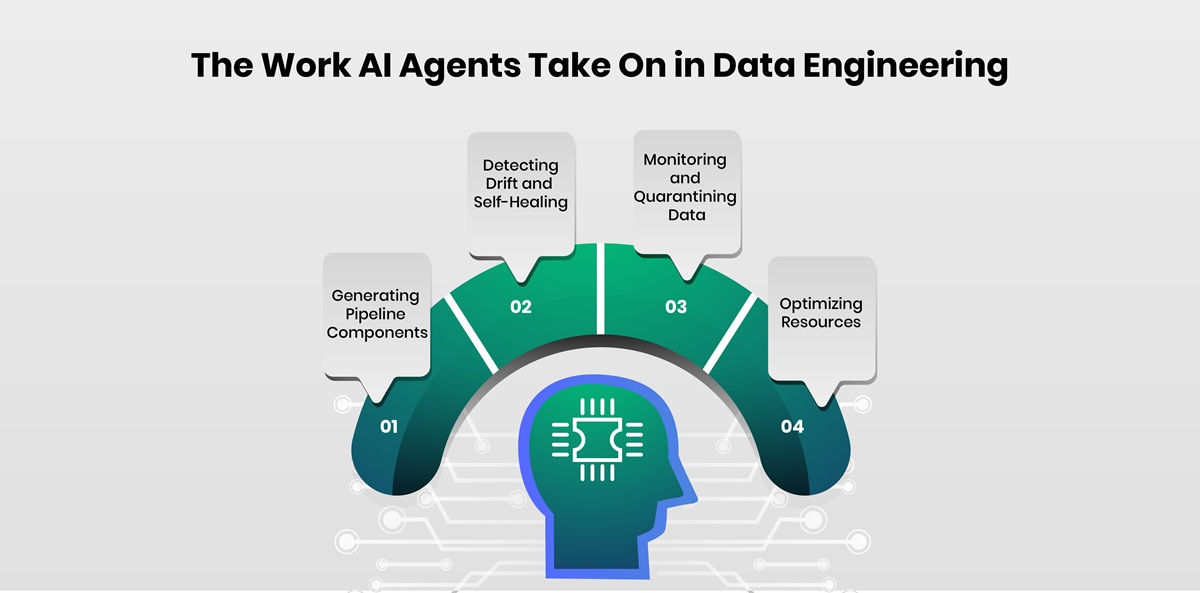
- Generating pipeline components. An agent can build ingestion workflows and transformation logic from a plain-language specification or by analyzing the structure of raw data.
- Detecting drift and self-healing. When a source schema shifts, the agent identifies the break and traces its impact, then repairs the affected pipeline before failures cascade downstream.
- Monitoring and quarantining. The system watches data quality in real time and flags anomalous records, isolating them so bad data never reaches a dashboard or a model.
- Optimizing resources. The agent tunes compute and query performance on its own, reducing the cost that manual pipelines quietly accumulate.
The performance of these tools has become concrete enough to measure. When Databricks launched its Genie Code agent in March 2026, it reported that on its own internal benchmark of real-world data science tasks, the agent solved 77.1 percent of tasks against 32.1 percent for a leading general-purpose coding agent.
That figure comes from the vendor’s own internal benchmark, so it is best read as a signal of direction and treated with the caution any self-reported result deserves. The direction it points in is clear enough that the category now merits your attention.
The Forces Driving Adoption
The move toward agentic data engineering is driven by three pressures that have converged at once. The first is the maintenance burden already described, which consumes the majority of engineering time on many teams and scales with every pipeline added.
The second is sheer volume. Modern platforms ingest data from hundreds of heterogeneous sources, and managing schema evolution and data contracts by hand across thousands of pipelines does not scale with a fixed headcount. The third pressure is the appetite of AI systems themselves, which need fresh, high-quality data flowing continuously. That demand multiplies the number of pipelines a team must keep alive and raises the cost of any pipeline that silently feeds bad data to a model.
Manual approaches reached a ceiling under these combined pressures. Agentic systems address the ceiling directly, because one that repairs and optimizes itself does not add linear cost with every new pipeline the way a manually maintained estate does.
The Limits of Automation
Agentic systems automate execution, but they do not automate judgment, and that distinction is where the human engineer remains essential. An agent pursues the goal it was handed, without deciding whether that goal is the right one or whether its output is correct for the business it serves.
The risk of removing the human is measurable. In its 2026 State of Analytics Engineering Report, dbt Labs found that 71 percent of data professionals cite incorrect or hallucinated outputs reaching stakeholders as a top concern, a worry that grows sharper as autonomous agents operate at speed.
An agent can generate a pipeline that runs without error and still produces subtly wrong numbers, and only an engineer who understands the data and the business can catch the flaw before it reaches a decision.
This is why the same report found trust in data rising to the top of organizational priorities. As agents accelerate output, the value of the human who can verify that output climbs with it. The engineer becomes the guarantor of correctness where automation can now produce large volumes of plausible output at high speed.
The Engineer’s Shifting Role
The role moves up a level, from producing pipelines to directing and auditing the systems that produce them. The responsibilities that stay human become the substance of the job:
- Setting intent. You decide what a pipeline is for and specify that outcome precisely enough for an agent to execute it, since the agent optimizes toward a goal it does not choose.
- Defining correctness. You establish what a right answer means in the business context, a judgment that draws on your understanding of the data and the stakes behind it.
- Owning governance. You hold the data contracts and compliance policies that keep the organization on the right side of regulation, even when an agent enforces them day to day.
- Auditing output. You design the guardrails the agents work within and evaluate whether their output can be trusted in production.
Every one of these demands a firmer grasp of fundamentals than the task it replaces. Directing an agent well requires knowing what a correct pipeline looks like before the agent builds it and recognizing a flawed one the moment it appears. An engineer who cannot read what an agent generates cannot catch the errors it makes, and those errors are the ones that reach production unnoticed. The engineer who can read that output and correct the agent’s course grows more valuable as the agent grows more capable, because a fast system acting on a weak instruction produces bad results faster than a human ever could.
That foundation in pipeline architecture and orchestration, along with observability, is what formal training in the field builds. The Associate and Senior Big Data Engineer certifications cover the ingestion and orchestration fundamentals at the center of that work, governance included. Those are the skills that let an engineer specify intent well and audit what an agent produces, which is the capability the agentic shift makes more valuable.
Building Readiness for the Shift
Preparing for this change is a matter of deliberate steps you can take while the tools are still maturing.
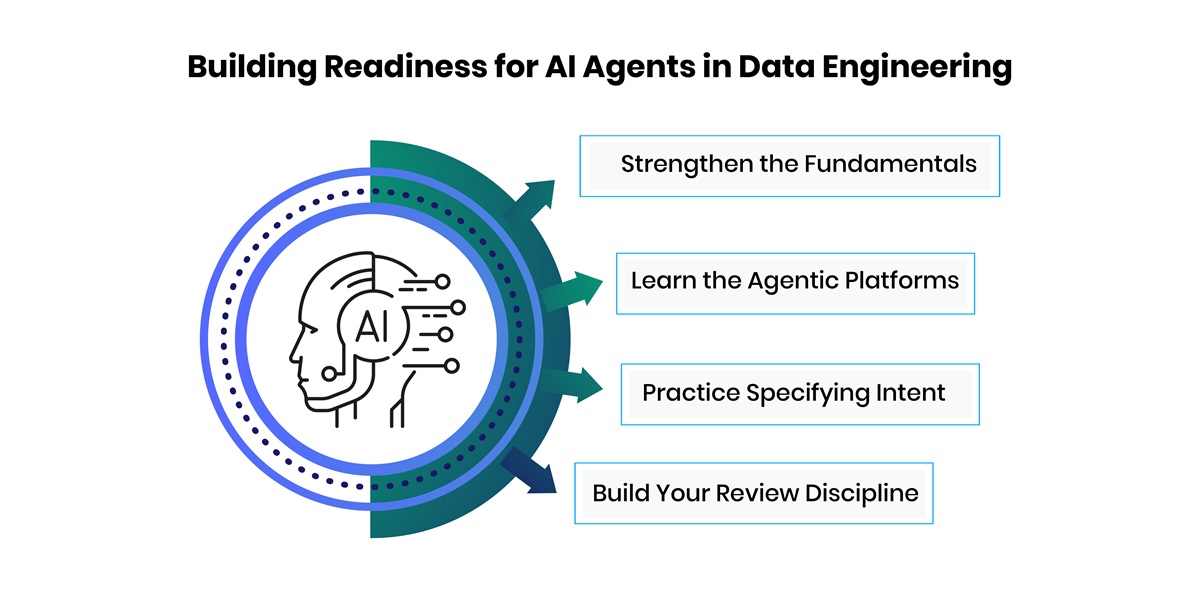
Step 1: Strengthen the fundamentals. Deepen your grasp of pipeline design and data modeling, along with orchestration, since these are the concepts an agent builds on and the ones you need to supervise its work. A structured path through recognized data science certifications is one way to build that foundation methodically.
Step 2: Learn the agentic platforms. Get hands-on with the systems adding agentic features, so you understand what they can do and where they fail.
Step 3: Practice specifying intent. Develop the skill of describing an outcome precisely, because a vague specification produces confident, wrong results at the scale an agent operates.
Step 4: Build your review discipline. Sharpen the habit of interrogating output before trusting it, a discipline that is becoming central to the work itself.
Conclusion
Agentic data engineering is changing what the job looks like. The question of whether that job still needs a skilled engineer has a clear answer, and it is yes. Agents are absorbing the construction and maintenance that once filled the week, and the value is moving to the decisions around them. Deciding what to build and how to constrain it, then judging whether the result can be trusted, is becoming the substance of the job. The engineer who can direct and audit these systems holds a stronger position than one who spent those hours typing pipelines by hand.