

















You spend six weeks building a model. The validation results hold up and the documentation is clean, so you present the work to the stakeholders who requested it. Someone asks why the output disagrees with their intuition about the customer base. The conversation moves on, and over the following weeks the project quietly loses its sponsor.
Since nothing failed, there appears to be nothing to fix. You start the next project carrying a question you cannot answer.
Weeks like that accumulate across a year. The pressure in data science rarely arrives as a single crisis. It builds through ambiguity about whether the work mattered and vigilance about systems that fail without announcing it, compounded by expectations shaped by people who have not worked with data directly. Generic advice about tech worker burnout tends to miss this, because it was written for roles where the output is visible and the feedback is quick.
This article looks at what burnout means under the clinical definition, then at the stressors that come specifically from data work and the changes that help at both the team and individual level. It is published for World Mental Health Day on October 10, and it offers a practitioner's account without standing in for clinical guidance.
How the Clinical Definition Frames Burnout
The World Health Organization defines burnout in the eleventh revision of the International Classification of Diseases, and the definition is more precise than everyday usage suggests. Burn-out is a syndrome resulting from chronic workplace stress that has not been successfully managed. WHO identifies three dimensions:
- Energy depletion or exhaustion: the tiredness that a weekend does not resolve.
- Mental distance from the job: increased cynicism or negativism about work that once engaged you.
- Reduced professional efficacy: the sense that your output no longer reflects what you are capable of.
The definition carries two qualifications worth holding onto. WHO classifies burnout as an occupational phenomenon and explicitly not as a medical condition, which situates the origin in the conditions of the work itself. WHO also states that the term refers to the occupational context and should not be applied to experiences in other areas of life.
Read together, the two qualifications undercut the assumption that burnout is a failure of personal resilience. Unmanaged workplace stress describes an organizational condition, and the wording of the definition is explicit about it.
The Stressors Specific to Data Science Work
Pressure is common to technical work, and several features of data science produce a particular version of it. Recognizing them gives the experience a name:
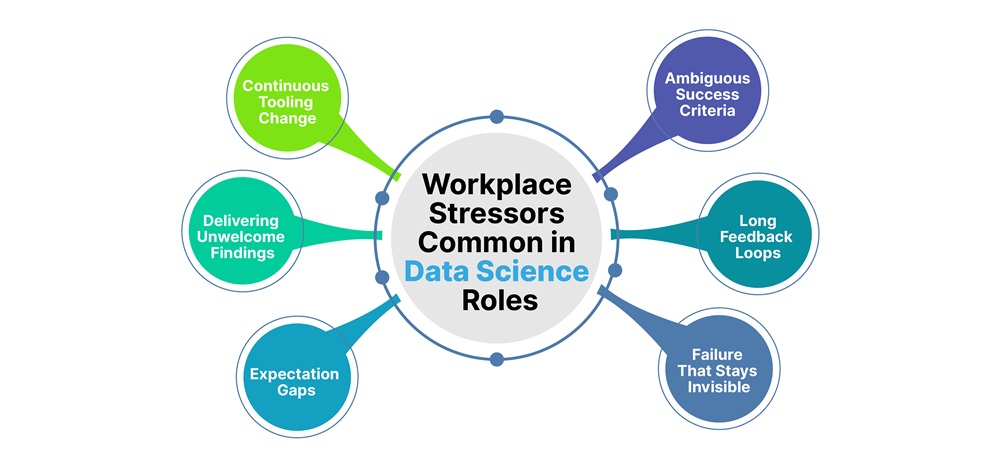
- Ambiguous success criteria: A model that reaches 0.84 on your chosen metric stays unjudged until someone decides what threshold the business needed. When that decision arrives after work, you cannot tell whether you did well. Agreeing on evaluation metrics before the modeling starts gives you a fixed reference point to judge the result against.
- Long feedback loops: Weeks can pass between starting an analysis and learning whether it changed a decision. Sustained effort is easier when feedback arrives regularly, and this work supplies it slowly.
- Failure that stays invisible: Models degrade silently as data drifts. Nothing alerts you the way a failed build does, so responsibility turns into low-grade vigilance that persists outside working hours.
- Expectation gaps: Stakeholders often want certainty the data cannot support. Explaining the limits of an estimate repeatedly, to people who hear hedging as incompetence, wears down even experienced analysts.
- Delivering unwelcome findings: The analysis sometimes contradicts a plan that people are invested in. Being the person who reports that carries a social cost that rarely appears in a job description.
- Continuous tooling change: The stack shifts faster than most people can absorb it, and the gap between what you know and what job postings list produces a background sense of falling behind that competence does not resolve.
Any one of these on its own is manageable. Sustained together over quarters, they match the chronic unmanaged workplace stress the WHO definition describes.
Why Individual Resilience Advice Falls Short
Workplace wellbeing guidance often addresses the individual, recommending better sleep and firmer boundaries alongside mindfulness practice. That advice is reasonable on its own terms, and it treats a structural problem as a personal one.
If the cause is unclear success criteria and slow feedback, then a meditation app changes how you feel about the conditions without changing the conditions. Framing burnout as a resilience gap also adds a second burden, since the person already exhausted now carries responsibility for not coping well enough.
Teams inherit that error when they respond. An organization that answers burnout with wellness perks while leaving the working conditions intact has treated the symptom and changed nothing underneath it.
The distinction also shapes what you can reasonably ask for. A meditation stipend is easy to approve and leaves the working day untouched. Agreeing on success criteria before a project starts takes more effort to arrange, and it reaches the part of the job that actually generates the strain. Naming the problem accurately opens that harder conversation.
What Teams and Managers Can Change
Reducing data science workplace stress depends largely on how work is defined and reviewed, which falls within the authority of team leads and managers. The measures below are addressed to that audience, and practitioners outside those roles can raise them with leadership.
Agree on what success looks like before the work begins. A written threshold, however rough, converts an open-ended question into a finishable task, and gives the team a defensible answer when expectations shift later.
Shorten the feedback loop where the work allows it. Interim check-ins on direction, even when results are incomplete, replace weeks of uncertainty with a signal a person can act on.
Make model monitoring a system responsibility. Automated alerting on drift moves the burden from a person's memory to infrastructure, which removes the background vigilance that steadily exhausts people.
Normalize negative results as findings. A team where ‘the data does not support this’ counts as a valid outcome removes the pressure to manufacture a finding, and it improves the quality of the analysis at the same time.
Protect blocks of uninterrupted time. Analytical work degrades badly under fragmentation, and a calendar broken into thirty-minute pieces makes competent people feel incompetent.
Close the loop on shelved work. When a project is dropped without announcement, saying so directly costs a manager very little and spares the analyst weeks of uncertainty. Silence after a delivery is read as a verdict, when the cause is often a reorganized priority that nobody thought to communicate.
Review workload against capability honestly. A team asked to cover data engineering and modeling while also owning stakeholder communication will do each of them under strain. The profession treats these as distinct roles with separate responsibilities, and noticing when one person has been asked to hold several of them falls to management.
What You Can Do for Yourself
The organizational changes matter more, and a few practices remain within your control while you work toward them. Each addresses a specific pressure described earlier:
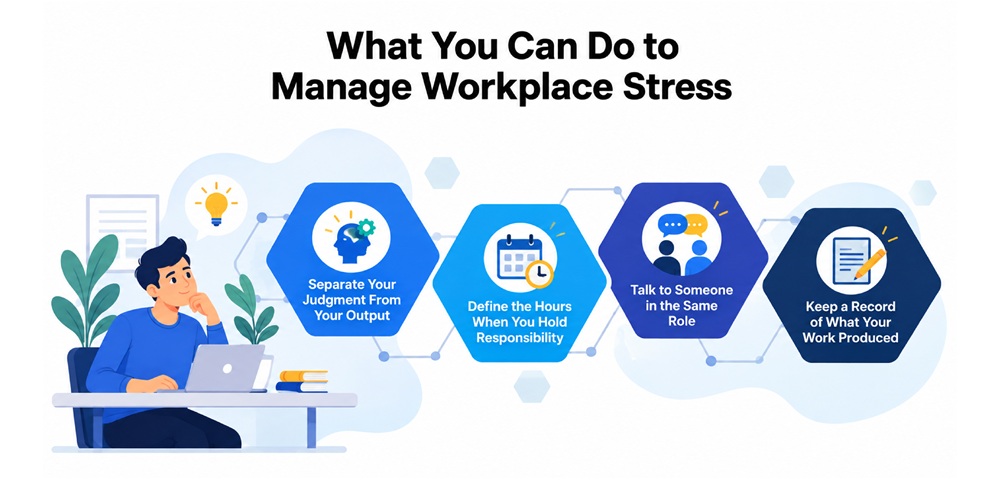
- Separate your judgment from your output: A well-designed analysis that produces an inconvenient answer is good work. Treating the reception of a result as a verdict on your ability leads directly toward the third dimension in the WHO definition.
- Define the hours when you hold responsibility: Alertness extends across whatever time you leave unspecified, so drawing that line protects the recovery periods that make monitoring duty sustainable.
- Talk to someone in the same role: Colleagues doing this work often recognize the experience immediately, and naming it reduces the isolation that compounds it.
- Keep a record of what your work produced: Shelved projects stay vivid in memory while the analyses that informed a decision leave no trace, which distorts your own view of your contribution. A short running log of what you delivered and what it changed supplies evidence to set against the sense of reduced efficacy.
None of this replaces changing the conditions. These practices help you protect yourself while that argument is still unresolved.
If the symptoms persist or extend beyond your working life, speak with a doctor or a qualified mental health professional. WHO's guidance is specific that burnout describes an occupational context, and clinicians assessing it look carefully at whether another explanation fits what a person is experiencing better. That distinction deserves a professional opinion, which a self-assessment cannot provide, and many employers offer confidential access to support through an employee assistance program.
Conclusion
Burnout in data science comes largely from the structure of the work, and the WHO definition supports that reading by attributing it to workplace stress that went unmanaged. Ambiguous success criteria and slow feedback, along with silent failure, are all conditions a team can change, which qualifies them as engineering problems.
The theme for World Mental Health Day 2026, set by the World Federation for Mental Health, is Lived Experiences Heard: Real Voices, Real Change. For a data team, that translates into a conversation about which of the pressures described above your own group actually carries. Bring one of them to your next retrospective and treat it the way you would treat any other recurring failure in the system.