



















Take a representative case. A churn model reaches 0.98 area under the curve (AUC) in validation, and the team ships it. Within a month its predictions are close to random. The post-mortem traces the cause to a single column, a field recording the date an account was closed. That value is recorded only after a customer has already churned, so the model spent training reading the outcome directly from the input.
This failure mode is data leakage, and it is harder to catch than a typical error because of how it presents. A bug that breaks your pipeline is visible immediately. Leakage produces a strong validation score, which is what a reviewer expects from working code, so it passes inspection and ships intact. Your score then reflects how much of the answer your pipeline supplied, which tells you little about how well the model generalizes.
This article covers what data leakage is and how it differs from overfitting, then works through the main types you will meet in a machine learning model pipeline. It closes with the reasons leakage survives code review and the checks that catch it before deployment.
What Data Leakage Is
Data leakage is the entry of information into the training process that will not be available when the model makes real predictions. The result is an optimistic performance estimate and a model that fails to generalize to new data.
The mechanism is consistent across cases. Information the model should not have reaches it during training, whether that is a value derived from the outcome or a statistic carried over from the test set. Because the evaluation data has been contaminated, the test set stops representing unseen data, and the error estimate it produces becomes a poor measure of generalization.
Leakage and overfitting get conflated, and separating them matters for diagnosis. An overfit model has learned noise specific to the training data, and the symptom is visible in the gap between its scores, where training accuracy climbs while validation accuracy falls. Leakage produces no such gap, since it inflates both numbers together. The failure appears only in production, where the leaked information is absent and the model has nothing left to rely on. Telling the two apart is part of the broader practice covered in this guide to model evaluation metrics.
The Main Types of Leakage
Leakage enters a pipeline through a small number of recurring paths. Knowing where each one originates tells you which part of your code to inspect:
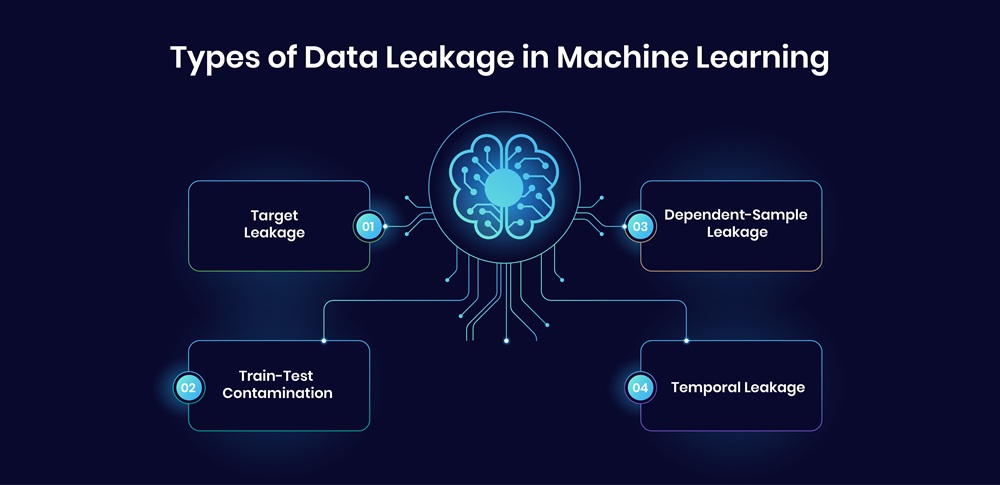
- Target leakage: A feature encodes the outcome it is supposed to predict. The cancellation date in a churn dataset is one example, and a hospital discharge code that only gets populated after a diagnosis is another. These features are legitimate columns in your warehouse, which is what makes them easy to include without noticing.
- Train-test contamination: A preprocessing step is fitted on the full dataset before splitting. Scaling and imputation both estimate parameters from the data, as does dimensionality reduction, so fitting them on everything transforms your training data using statistics drawn from the test set.
- Dependent-sample leakage: Related records land on both sides of the split. Repeat customers and family members in a research cohort break the assumption that samples are independent, as do multiple image slices taken from one patient. The model then recognizes a near-duplicate it has already seen, which inflates the score without any gain in generalization.
- Temporal leakage: A random split shuffles time-ordered data, which lets the model train on future observations and predict the past. Any forecasting task needs a split that respects chronology.
The table below maps each type to the point in the pipeline where it enters and the fix that closes it:
| Leakage Type | Where It Enters | Typical Symptom | Fix |
|---|---|---|---|
| Target leakage | Feature selection | One feature dominates importance scores | Audit features for post-outcome data |
| Train-test contamination | Preprocessing | Scores drop sharply on fresh, unseen data | Fit transforms on training folds only |
| Dependent-sample leakage | Data splitting | Performance falls when groups are held out | Group related records into one fold |
| Temporal leakage | Data splitting | Backtest beats live performance | Split chronologically |
The peer-reviewed survey Overview of leakage scenarios in supervised machine learning, published in the Journal of Big Data in 2025, documents these paths alongside subtler ones, including leakage that flows between test samples when preprocessing parameters are estimated separately on the test set.
One case from that survey shows how ordinary the mistake looks in practice. A team building a diagnostic model from radiology images has experts label each scan, and while labeling, those experts also record notes on the size and location of any abnormality. Including those notes as features produces excellent cross-validation scores, because the notes carry the diagnosis the model is trying to reach. The model cannot be deployed, since the system exists to work without manual annotation, and no such notes accompany a new scan. The code contained no defect, and the performance estimate it produced described results the model could never reproduce in use.
Why Leakage Survives Code Review
Three structural conditions let leakage persist in published work and deployed systems, and they explain why capable teams still ship it.
Consider the symptom first, which presents as a strong result. A model that beats the benchmark invites little scrutiny, and the incentive to interrogate a good number weakens further on a team under deadline pressure.
Then consider how methods get described. A written account of a method can read as correct while the code underneath leaks. The survey cited above documents a case where the authors described performing feature selection and hyperparameter tuning inside a cross-validation loop, which sounds right. Reading the implementation revealed that the two steps ran in separate loops, and the first loop had selected features using the full dataset before the second loop started. Every sentence in the write-up was defensible, and the pipeline leaked anyway.
Reproducibility then compounds the problem. A pipeline that returns identical results on every run can be consistently wrong, and anyone rerunning the code inherits the same flawed split along with the same inflated number.
How to Detect Leakage in Your Pipeline
Detection starts when you treat a surprising result as a question about your pipeline. Four checks will surface most leakage before it reaches deployment, and each one targets a different path from the table above:
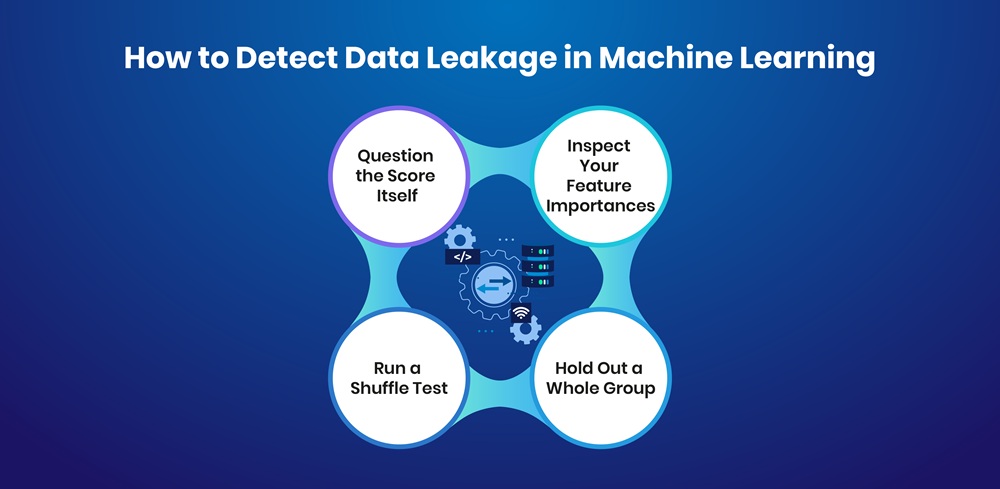
- Question the score itself: A number far above what the problem should allow, or a jump that follows adding one new feature, deserves investigation. Domain knowledge is the most reliable guide here, since a fraud model reaching 0.99 AUC on a detection task known to be hard is evidence about your pipeline more than your model.
- Inspect your feature importances: When a single feature carries most of the predictive weight, trace where that column comes from and at what point it is written. Then ask the deployment question. At the moment you need a prediction, does this value exist yet? A field that gets filled in after the outcome cannot appear in training.
- Run a shuffle test: Randomly permute your target variable, which destroys any true relationship between the features and what you are predicting, then retrain on the shuffled labels. Performance should collapse to chance, and anything meaningfully above chance means your pipeline is finding a path to the answer that bypasses the underlying signal entirely.
- Hold out a whole group: Take a group your current split keeps together, an entire customer account or a later time period, and compare the result against your reported score. A large drop points to dependent-sample or temporal leakage, since the model was relying on proximity to records it had already seen during training.
Running the checks in that order narrows the diagnosis as you go. A score that survives the first three and then drops sharply under a grouped split points you at the split itself, which is quicker to correct than auditing every column in your feature set.
How to Prevent Leakage
Prevention depends on how you structure the pipeline, and four practices handle the paths described above.
Step 1: Split the data first. Partition the dataset before any analysis, then set the test portion aside until final evaluation. Every decision that examines data, including imputation strategy and feature selection, belongs on the training side of that line.
Step 2: Encapsulate transforms in a pipeline object. Fitting a scaler on the full dataset is a frequent contamination path, and the fix is to bind preprocessing to the estimator so both are fitted on training folds together. The snippet below shows the correct pattern in scikit-learn:
Fitting StandardScaler on X before this call would leak test-set statistics into every fold, and the resulting score would be optimistic by an amount you cannot measure.
Step 3: Match the split to the structure of your data. Random splitting assumes independent samples, so use grouped splitting when records cluster by customer or subject, and split chronologically for anything time-ordered. Work out what the model will face in production, then build a split that mirrors those conditions.
Step 4: Use nested cross-validation when tuning. Selecting hyperparameters on the same folds that estimate performance turns those test folds into training data, because you made a decision using them. An inner loop handles selection and an outer loop estimates generalization, which keeps the two roles separate.
These practices are what carry a model from strong notebook numbers to dependable behavior once deployed. The Senior Data Scientist (SDS™) certification covers that evaluation discipline directly, validating the ability to build and assess models that behave predictably once deployed. You can explore the foundations further across the world of data science.
Conclusion
Data leakage turns your validation score into a measurement of your pipeline construction, leaving the quality of your model unmeasured. It survives review because the evidence of a problem is a stronger score, and it surfaces only when the leaked signal disappears in production and performance falls to what the model actually learned.
Take one concrete step with your current project. Pull your feature list and ask of every column when its value gets populated relative to the outcome you are predicting. Remove anything that only exists after the fact. That single audit catches target leakage, the costliest type to discover late, and pairing it with a split matched to the structure of your data will keep your reported numbers trustworthy.