


















Small language models are now fast and cost-efficient enough to evaluate every event flowing through a live data pipeline and support continuous real-time processing beyond periodic batch jobs. While the underlying architecture is somewhat straightforward, maintaining system-level accuracy over time is significantly more difficult and often receives far less attention in technical discussions.
Modern operational environments generate enormous volumes of telemetry from cloud workloads, identity providers, applications, APIs, and endpoint systems. Rule engines reliably detect predefined signatures, while batch analytics identify broader historical patterns. However, a large portion of operational decision-making still depends on manual interpretation of logs, behavioral anomalies, and contextual signals to determine whether unusual activity reflects malicious behavior, system drift, or legitimate operational events.
As data velocity increases, this dependence on human review becomes more and more difficult to sustain. Alert queues expand faster than analysts can investigate them; response latency grows, and inconsistent classification decisions begin to affect production reliability. The challenge now centers on maintaining accurate, context-aware interpretation at production scale in real time.
Until recently, most production systems lacked low-latency language models capable of operating directly within streaming pipelines before manual review occurred. That limitation has changed.
Small language models (SLMs) in the 1B to 8B parameter range can support inference workloads that previously required substantially larger models. They are now fast enough to operate directly within live streaming pipelines, cost-efficient for continuous evaluation of high event volumes, and sufficiently accurate on bounded tasks such as classification, tagging, anomaly labeling, and field extraction.
The remaining challenge involves sustaining model accuracy under changing operating conditions.
What Has Changed
Over the last eighteen months, the following three infrastructure and model-level advances have significantly changed the economics of real-time language inference:
1. Small language models became significantly more capable.
Fine-tuned open models in the 3B parameter range can now match frontier-scale models on many bounded tasks like classification, tagging, and extraction, while operating on a single GPU and, in some cases, even on CPUs. This has reduced inference costs substantially for production language-processing workloads.
2. Serving infrastructure has become far more efficient.
Continuous batching systems improved throughput by grouping concurrent inference requests into rolling execution windows instead of static execution batches. Frameworks such as Orca and vLLM contributed significantly to lower latency, higher hardware utilization, and more stable streaming inference performance under production load.
3. Aggressive quantization reduced the hardware requirements needed to run deployed models at scale.
Operating models at 4B precision or lower made it possible to deploy workloads that previously required high-end GPUs on far more affordable commodity hardware, often with minimal accuracy loss on bounded tasks.
These advances made streaming inference operationally viable for high-volume event processing.
Production Use Cases for Streaming SLMs
In security operations environments, streaming SLMs assign triage labels to events before they enter the Security Information and Event Management (SIEM) system. Events are classified as benign, suspicious, or critical before reaching the analyst queue, helping teams prioritize investigations earlier in the pipeline. Free-text logs and alert descriptions are converted into structured fields such as source asset, target asset, technique, and observable to improve downstream correlation and analysis. Threat intelligence feeds and vendor advisories are also summarized during ingestion.
The same architectural approach applies to customer support and transaction processing environments. Customer-support systems use streaming SLMs for ticket classification and intent routing, while transaction-processing systems extract structured attributes for fraud analysis and risk scoring.
Reference Architecture for Streaming SLM Systems
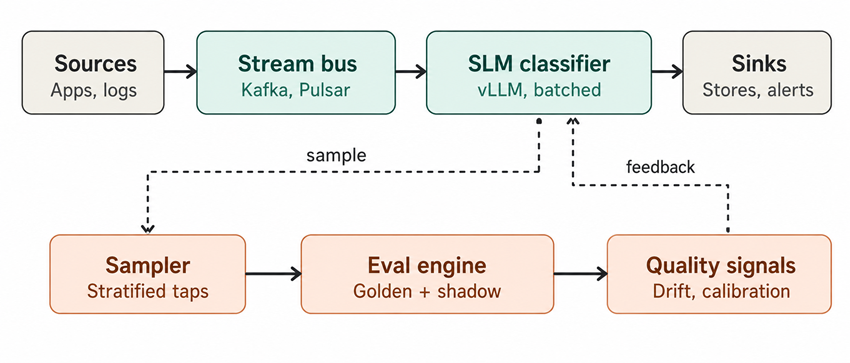
The visual above has two lanes. The top one is the primary inference path where events arrive on a durable stream bus (Kafka, Pulsar, Redpanda), get parsed and enriched by a stream processor (Flink, Spark Structured Streaming), pass through the SLM classifier (vLLM is the default for GPUs; llama.cpp for CPU and edge), and land in the analyst queue, the warehouse, the search index, and the SIEM. This topology is widely used in large-scale streaming environments.
The second lane handles continuous evaluation and feedback. It is an evaluation loop that continuously samples classified events, applies multi-method validation, and returns quality signals to the inference pipeline. There are three implementation patterns that significantly affect hot-path reliability and throughput.
- Continuous batching increases throughput efficiency. Calling the model once per event wastes most of the GPU. Rolling batches are the only configuration that makes per-event economics viable. This configuration is for stable per-event inference economics.
- Structured output enforcement is required for operational reliability. The model emits a label, a confidence score, and the required attributes, never a free-text guess. Constrained decoding eliminates the parsing failures that streaming pipelines amplify into incidents.
- Confidence-based routing provides a fallback. When the model is uncertain, meaning confidence falls below a calibrated threshold. The event escalates to a larger model, a human reviewer, or a default class with an “unsure” flag attached. The threshold is tuned from the evaluation lane, not guessed at deployment.
Why Evaluation Is Part of the Architecture
Continuous evaluation introduces the primary operational complexity in streaming SLM systems.
In traditional machine learning, evaluation is a release gate, i.e., test, sign off, and ship. In real-time analytics though, evaluation must run continuously, alongside the model in production, because the world the model is classifying is itself changing. With the emergence of new attack patterns, vendors update their alert taxonomies. New software ships new log formats. This phenomenon is known as concept drift, and production models operating on non-stationary streams typically experience a gradual performance degradation over time. By the time drift appears in downstream metrics such as false-positive rates or declining detections, model quality may already have degraded for an extended period. The evaluation lane operates independently from the primary inference. It classifies events. It samples those classifications, checks them against multiple sources of truth, and signals back when the production model is drifting out of tolerance. Both operate continuously and independently. Without continuous evaluation, classification errors accumulate over time and affect downstream operations. The evaluation lane relies on three core mechanisms.
Sampling has to be stratified by predicted class, confidence bucket, and event source because random sampling averages away exactly the failures you most want to catch. A throughput rate of 1-5% is a reasonable starting point, with higher rates allocated to recently retrained models and to classes known to be volatile.
Multi-method evaluation has to combine a curated golden set (a few hundred hand-labeled examples for regression coverage), shadow inference against a larger reference model (rising disagreement is a leading indicator of drift), and selective use of LLM-as-judge for ambiguous cases where binary labels are insufficient. Each method has limitations individually, while combined evaluation produces more stable validation coverage.
The loop also has to close operationally. Drift signals from the evaluator update the confidence-routing threshold, the model registry’s promotion decisions, and retraining triggers. Quality signals must feed back into production controls and retraining decisions.
In this architecture, the model operates within a larger evaluation system.
Common Failure Modes in Production SLM Systems
Several production issues appear repeatedly in streaming SLM deployments. SLM deployments require different latency and concurrency assumptions than frontier-model API deployments. Do not skip structured output enforcement on the assumption that the model "usually" returns valid JSON; a 0.5% parse-failure rate on fifty thousand events per minute is 250 broken events every minute. Evaluation cannot remain limited to release-stage validation. Without continuous evaluation, classification accuracy degrades over time under live operating conditions.
End Notes
Small language models expand the range of tasks that real-time analytics systems can process during live event streams. In production environments, long-term reliability depends on continuous evaluation, calibration, and monitoring under changing operating conditions. Evaluation infrastructure should be established before large-scale deployment because long-term model accuracy depends on continuous monitoring and feedback.
About the Author