
















Every April 7, global attention turns to public health priorities, system capacity, and population-level risks. World Health Day 2026 centers on the theme: Together for health. Stand with science.
The World Health Organization’s campaign emphasizes scientific collaboration as a core requirement for health protection across human, animal, and environmental systems. Current health challenges are interconnected and require coordinated, multi-domain responses. Data science plays a critical role in enabling this coordination.
Data as a Foundation for Health Systems
Scientific progress depends on evidence, and evidence depends on data.
Clinical trials, epidemiological studies, and disease surveillance systems rely on structured data collection and analysis. Lessons from the past crises, especially the COVID-19 pandemic highlighted differences in response capability across regions. Outcomes were influenced by:
- Strength of data infrastructure
- Availability of analytical capacity
- Speed of decision-making based on data
Gaps in these areas resulted in:
- Delayed disease modeling
- Limited supply chain visibility
- Inefficient vaccine distribution
Data-driven systems are essential for timely and accurate public health responses. Data scientists support this by building models, interpreting patterns, and enabling decision frameworks.
One Health and Integrated Data Systems
The One Health framework recognizes the interdependence of human, animal, and environmental health systems.
Key factors include:
- High proportion of infectious diseases originating in animals
- Expansion of vector-borne diseases due to climate change
- Impact of agricultural practices on resistance patterns
These factors operate within a connected system.
Data science supports this framework through:
- Integration of diverse datasets
- Cross-domain analysis
- Modeling of interdependencies and delayed effects
Applications include:
- Real-time monitoring of livestock health data
- Linking environmental indicators with outbreak risks
- Predicting health impacts based on climate patterns
These use cases require consistent data handling across domains.
Data Infrastructure in Scientific Collaboration
Scientific collaboration depends on effective data systems.
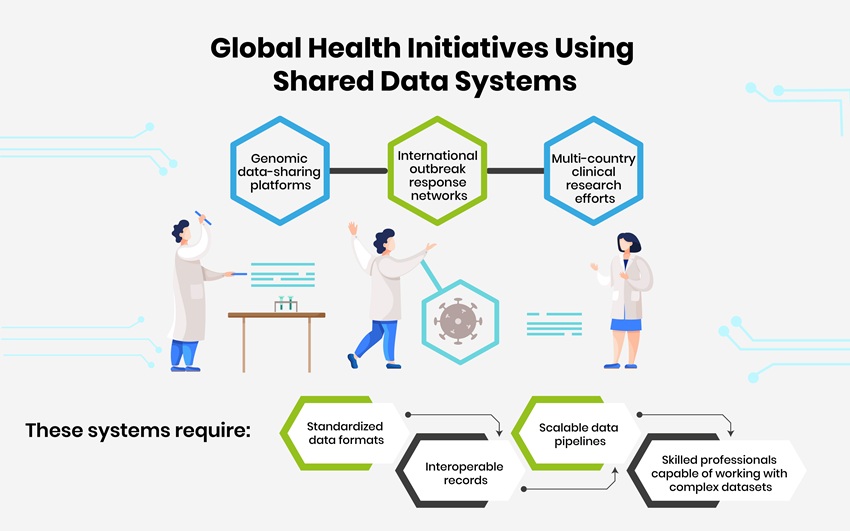
The ethical handling of health data is equally critical. Key considerations include:
- Privacy protection
- Informed consent
- Fair and unbiased analytical models
Responsible data practices support trust and reliability in health systems.
From Data to Decision: Role of Structured Expertise
Data alone does not produce outcomes. Skilled data science professionals are required to convert data into decisions.
This includes the ability to:
- Prepare and validate datasets
- Build and test analytical models
- Interpret results for applied use
- Communicate findings to stakeholders
These capabilities are developed through structured learning and validated training.
Health and research institutions increasingly require credentialed professionals to ensure:
- Consistency in applied skills
- Alignment with global standards
- Reliability in high-impact decision contexts
In public health, analytical accuracy directly affects outcomes. Professional competence is therefore essential.
Conclusion
World Health Day 2026 highlights the role of science in addressing complex health challenges. Effective application of science depends on systems, data, and skilled professionals.
Data science supports how health systems are analyzed, connected, and improved. Its role continues to expand across global health environments.