











The data analyst has now become much more than a data cruncher. The analysts of today can freely transition between writing data analyses using SQL and reading intricate patterns and influence the boardroom discussions. Their process cuts across business acumen and technical expertise, and they translate information into action. This playbook underscores how a sharp query, clear analysis, and effective data storytelling can be used to turn raw data into strategies that can help organizations achieve measurable impact.
SQL Fundamentals Every Data Analyst Must Know
SQL is an indispensable skill to master for data analysts. It begins with the use of SQL to query, filter, and aggregate data. With their ability to use commands such as SELECT, JOIN, GROUP BY, and WHERE, analysts are able to process unstructured tables and get the structured dataset ready for in-depth analysis. According to the 2024 Stack Overflow Developer Survey, SQL is used by 54.1% of developers, emphasizing its widespread use and popularity.
Beyond basic queries, SQL allows data transformation and filtering nulls, reshaping records, and generating calculated fields. This layer of preparation ensures the data set is reliable and in line with business logic.
Important capabilities for every analyst to master:
- Joins and relationships: Combine multiple tables to enrich the context.
- Aggregations and Window functions: Summarize and calculate rolling or ranking statistics.
- Filtering and Subquery: Highlight relevant segments and construct nested logic.
- Performance tuning: Execute efficient queries that scale with large datasets.
The downstream tasks (visualization, statistical modeling, and storytelling) will be easier for an analyst as long as they write a clean, performant SQL query. SQL is not only a technical tool but also the gateway through which the data analyst gains insight from complexity.
From Data Cleaning to Pattern Recognition
The path from raw data to actionable insights in data analysis is laid with careful processes. Among them, the process of data cleaning and pattern recognition can be considered some of the most critical steps that convert a disorganized set of data into a consistent storyline.
Data Cleaning: Laying the Groundwork
The basic process of detecting and correcting errors or inconsistencies within the datasets to guarantee their accuracy and reliability is known as data cleaning. This is an important step because analysts are known to waste about 70-90% of their time in data preparation. A study conducted by Editverse confirmed this fact by stating that this huge time investment highlights the significance of efficient data cleaning methods.
Key Techniques in Data Cleaning:
- Handling Missing Data: The use of techniques such as imputation or deletion to deal with missing data.
- Removing Duplicates: Deleting duplicate entries to avoid biased analysis.
- Standardizing Formats: Making sure that the data is represented consistently throughout the dataset.
- Identifying Outliers: It is a process of identifying and fixing the abnormalities that may misrepresent the analysis.
Pattern Recognition: Unveiling Insights
Pattern recognition is the next step that follows data cleansing, and it involves the identification of trends, correlations, and structures in the data. This is necessary in the making of informed decisions and predictions.
Applications of Pattern Recognition:
- Trend Analysis: It involves the determination of changes in data with time to predict future results.
- Anomaly Detection: The identification of oddities that can be a sign of problems or opportunities.
- Clustering: The similar data points are combined to reveal underlying structures.
- Classification: The process of grouping data into predefined labels that are to be analyzed.
Analytics Beyond the Query: Visualization and Tools
Once data analysts receive raw outputs of data supplied by your SQL, the next step is to convert rows and columns to meaningful images. Visualization is not an aesthetic add-on; it is the intermediary between analysis and understanding.
Visualization tools help you:
- Transform tables with lots of data into charts, heat maps, and interactive dashboards.
- Glance at surface trends, correlations, and outliers.
- Empower the non-technical stakeholders in understanding intricate patterns in a short period.
These tools also streamline your workflow. An analysis of US firms revealed that the implementation of sophisticated visualization tools assisted in simplifying the process of decision-making and enhanced the precision of interpreting business intelligence reports.
Technically, modern tools are directly connected to query results and have real-time refreshing functionality. It is possible to stack the data sources, use filters, and cascade insights without writing queries. The more advanced ones also feature exploratory visual analysis, where you can interactively filter views during exploration. As an example, Tableau provides dynamic dashboards that let users explore interactive visuals, while PyGWalker provides a simple interface with immediate response to changes, assisting code exploration by the analyst alongside code.
Data Storytelling as a Strategic Skill
Data-driven insights are not all in strategy conversations. It is data storytelling that brings such insights into action. It puts numbers into perspective and places a data analyst in the middle of quantitative complexity and executive decision-making.
Companies that used data storytelling had evident returns. A survey of more than 650 practitioners in November 2024 found that 64 percent reported an improvement in communication with stakeholders and 55 percent reported a direct benefit of better decision-making.
The fundamentals of successfully telling data stories:
- Context: Start with a context of why the data is important. What is the question or problem it is answering?
- Clarity: It is better to outline several important points instead of bombarding the audience with all the metrics.
- Credibility: Apply established procedures, disclose assumptions, and display weaknesses.
- Narrative Flow: Build tension or a gap, and lead the audience somewhere to a conclusion or revelation.
- Call to Action: What is the next thing that the business should do? Give specific recommendations, not general ones.
The combination of narrative and visualization can be demonstrated by looking at the S-DIKW Framework that was presented in 2024. It builds upon the traditional DIKW model (Data → Information → Knowledge → Wisdom) by incorporating story on every level. In that manner, raw numbers develop in an organized manner into an attractive story.
From Analyst to Advisor: Communicating at the C-Suite Level
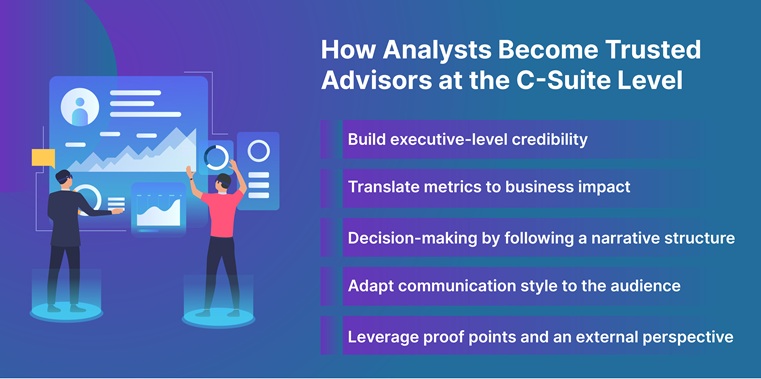
The transition between conducting analyses and influencing organizational direction is the transition to being a trusted advisor. In the case of a data analyst, such a transition depends on clarity, credibility, and strategic framing.
-
Build executive-level credibility
Executives prioritize precision and clarity while scrutinizing ambiguity. When presenting findings, it is imperative to explicitly state assumptions, data limitations, and confidence levels. This transparency fosters credibility and demonstrates analytical maturity. Over time, the consistent delivery of accurate and transparent insights transforms your work from mere reports into reliable strategic inputs. -
Translate metrics to business impact
You will wish to redefine numbers as results. As an example: "This is a downward trend that will decrease retention by 12 percent in 6 months and potentially cost the company USD 2 million in yearly revenue is more convincing than retention went down." Personalize communication in a way that every insight is connected to revenue, risk, cost, or growth. -
Decision-making by following a narrative structure
Present your speech in the following flow:- Problem statement: What is it we are here to inform?
- Main point: The point that your data validates.
- Implications: What this implies for the business.
- Recommendation: Detailed, practical follow-up.
-
Adapt communication style to the audience
C-suite executives are concerned about the so what. Avoid technical jargon. Make summaries in bullets, with detailed backup annexures. Be prepared to make a pivot: some will require more details, others will be interested in the headline. -
Leverage proof points and an external perspective
Where feasible, support your intuition using external standards or research within the industry. Indicatively, according to the 2025 Thomson Reuters C-Suite Survey, 82 percent of the executives prioritize digital transformation as high, which indicates that they are open to data-driven agendas.
Conclusion
The movement from learning SQL as a data analyst to creating data stories that resonate reflects how the role of the data analyst is changing. The bases are laid down by technical skills, but interpreting insights into explicit, practical stories takes impact to the next level. Precision and strategic communication enable analysts to transform into decision makers rather than query executors because they form trusted collaborators that connect data and business goals in impactful and influential ways.